Popular Posts

Showing posts with label Granada. Show all posts

16 July 2012

Photo diary: Street artists and performers of Granada, Spain


An artist sketching on a piece of paper attached to the side of a building in the Albaicín

A festival/procession in the Albaicín that we discovered was about an amputated finger (that was supposedly in the box in the middle of that hut that they're carrying) that was done every year in October

A dragon controlled by people dressed up for the Medieval Festival next to Rio de Genil in Granada, Spain

A couple dancing Sevillana with two men playing guitar in the background at the Mirador de San Nicolas in Granada, Spain

The same two men playing guitars on a Saturday in January at the Mirador de San Nicolas

One of my favorite artists drawing a Sharpie landscape of Plaza Nueva in January 2012
Here's his blog if you are interested: http://thelostphotographer.blogspot.com

The same man sketching the other side of Plaza Nueva in March; He sketched on the ground of Plaza Nueva almost every Saturday and Sunday

15 July 2012

Typical Spanish dishes: Sopa de Picadillo


                When I studied abroad with API, the housing options we had were a home stay, a residencia, a shared apartment, or independent living.  I elected living with a family in a home stay during my first semester abroad. This meant that I would live with a Spanish family and my host mom (or dad) would do my laundry once a week, provide 3 meals a day, and cleaning once a week. One of the best things about this option (besides the great daily Spanish practice with a local) is the food. My host mom, Maria Jose, was a fantastic cook. She believed that a proper meal always consisted of a first plate, a second plate, and bread. While I was living with her, I took to habit to take pictures of almost all of our meals. Here, I will share with you some of the typical Spanish dishes she cooked for me!

                To start things off, one of my favorite dishes:  Sopa de Picadillo

The lunchtime spot: the kitchen table of Maria Jose


                This dish has shredded chicken, small thin noodles, carrots, and cooked egg. Sopa means soup in Spanish and Picadillo means mince, such as minced meat. So Sopa de Picadillo means a soup of minced meat. In this photo, the meat is not so much minced as it is shredded. This soup is delicious during colder weather; it’s a perfect pick-me-up! That day, it was served with a side place of an egg, ham, and green bean omelet as well as bread (what I observed as a huge staple in the Spanish diet) 


Sopa de Picadillo


Stay tuned for more pictures and 
information about typical Spanish dishes!

x

04 July 2012

Oh the places you’ll go! : Granada, Spain


                I’ve decided to start a little series of post called Oh the places you’ll go! Throughout this series, each post will be focused on a different city that I’ve been to and recommendations that I have about hostels, food, and places to go. 

                I decided it was only appropriate to start with the city that captured my heart and where I have just called home for a year: Granada, Spain. 

                First off, if you haven’t been to Granada yet, you need to go. This is my favorite city in Spain for numerous reasons that would take a whole different post to list. Instead, here is what I consider some of the best food and drink places in Granada that should be visited if you ever have to good fortune of going. Since I was there for some time, some have two choices because, well, it’s like trying to pick your favorite child—you just shouldn’t do it.

Favorite overall café:
 Mundo Manila (Realejo, near the statue of Isabella and Colon)
-          All their food is delicious (yeah, I actually do mean all), the atmosphere is what I would call ‘global relaxation’, and the staff is super nice
-          Placeta de las Descalzas, 3
18009 Granada, Spain

Favorite breakfast place:
Mundo Manila (Realejo, near the statue of Isabella and Colon)
-          Placeta de las Descalzas, 3
18009 Granada, Spain

Hicuri (Realejo)
-          They have great ‘tostadas’ with scrambled eggs, which is a luxury considering the Spaniards don’t normally eat or offer eggs for breakfast
-          They also offer whole wheat bread for tostadas
-          Awesome artwork/décor inside
-          Calle Santa Escolastica, Esquina Plaza Girones 4,
Granada, Spain

Hicuri Restaurant and Bar

One of the paintings inside of Hicuri
Photo credit: Jiela Peyman


Favorite wine:
                La Ermita (Centre)
-          Their semi-sweet white wine is my favorite but frankly, every wine I had there was good
-          They are also the reason I learned to like olives—they’re the best there!
-          Great gazpacho, nice staff, and prime location right next to the Cathedral of Granada. I could sit in that plaza sipping on wine all day long!
-       Cárcel Baja, 1, 18001, Granada 

The view from the plaza where Ermita is located-- can't get much better!


Favorite tapas:
                Bubión
-          My ABSOLUTE favorite tapas bar, ever ever ever
-          Calle Socrates between Calle Pedro Antonio and Camino de Ronda
-          Their Tinto de Verano (half red wine, half lemon Fanta) here is amazing and their tapas are phenomenal. Plus, you get to choose what you want!
-          Favorites?
o    Pechugas de pollo: The chicken and fries with a garlic-lemon aioli sauce
o    Carne en salsa: The meat in sauce
o    Croquetas : croquettes
o    Paella: this is usually a ‘Tapa del día’ but whenever I’ve had it, it’s delicious. It’s a typical Spanish rice dish

Bubión is on the left

LAX
-          Great eggplant with honey among other things
-          You get to choose your own tapa here and they’re all wonderful so it’s a win-win
-          Follow Calle Puentezuelas until you reach Calle Paz and take a left and go all the way down the street

Chicotá (Centre)
-          Great wine and wonderful tapas
-          You don’t get to choose your own tapas but they’re pretty much all good so it’s a safe bet
-          Calle Navas, about mid way down

Photo credit: Jiela Peyman


Favorite fancy coffee place:
                Il Caffe di Roma (Centre)
-          Their normal coffee is fine too but they have a large selection of ‘fancy coffee’ options too that are delicious
-          Plaza BibRambla

Il Caffe di Roma in Plaza BibRambla


Favorite ‘pan’ place aka bakery:
                Name is unknown but I have supplied a picture and directions
-          Their fresh baked loaves of bread are the best thing since, well, sliced bread. Almost  always warm, fresh out of the oven. A great accompaniment to any meal—and only .65 euro cents!
-          They also have a pastry that is like a log donut, covered in sugar, stuffed with Nutella, and then drizzled with chocolate— .95 euro cents and it’s a wonder how I didn’t get one every day
-          The sign says ‘Pizza al tallo, pizza, croissant’
-          The corner of Calle Pedro Antonio de Alarcón and Calle Emperatriz Eugenia

My favorite bakery


Favorite Gelato:
               Heladería Tiggiani (Centre)
                              -       Great gelato, tons of flavors, big portions, and cheap. How do you say no to that?
                              -       Plaza BibRambla


               Los Italianos (Centre)
-          The most famous gelato place in Granada and for a good reason. Although you get a small amount, it’s expensive, and sometimes you feel like you’re in a crowded bar trying to get a drink, it’s worth it to go
-          Don’t get it in a cone… it’s a rip off, trust me
-          My favorite combo: Chocolate and Hazelnut
Favorite bar:
                Tantra Bar
-          Great atmosphere and place to hang out with friends
-          Wander the streets like Calle Elvira beforehand because many times, they have reps walking around giving out deals on beer that are worth it
-          Feel like dancing after? One of the popular discotechs in Granada is owned by the same person. After you get a drink, go up to the bar and ask the bartender for however many free passes to Granada10 and then go off and dance the night away!
-          Calle Álvaro de Bazán, 9, right off of Gran Via
-          Granada 10 is 2 streets down on Calle de la Cárcel Baja

Great hangout:
                Damasqueros (Realejo)
-          Great atmosphere and close to the Center of Modern Languages
-          There are couches indoors and seating outdoors. Great place to spend an afternoon for a drink
-          Follow Calle Sta Escolástica from the statue of Isabella and Colon down and take a left onto Cuesta del Realejo. It’s across the street from where Cuesta del Realejo and Calle de los Molinos meet


Happy traveling and happy 4th!
x
 

23 April 2012

Semana Santa


                About two weeks ago, España had a 10 day break of school to celebrate Semana Santa, known in English as Holy Week. Holy Week here should be on everybody’s bucket list in my opinion. It was nothing like I’d ever seen before. It started Saturday, April 1st. Holy Week here is filled with processions throughout the city of floats, first with a depiction of Jesus followed by a float of the Virgin Mary. The whole procession has an order that every procession follows. (keep in mind, this is a rough description) It always starts with someone carrying a cross in the front, then a lot of people dressed up in pointy face covers (more about that later) then some depiction of Jesus, then women dressed in black with big black veils on carrying a rosary, and followed by the Virgin Mary.
                For any American, the sight of the uniforms for the persons of these processions is a bit unsettling at first. Why you ask? Well, the sight of these uniforms is linked to a horrible time in our history and quite an awful group, the Ku Klux Klan. The uniforms are a large cloak with one of the pointy head pieces where you can only see the eyes. Each procession has a designated color ranging from blue to deep purple to brown to white (where it really reminds you of the KKK) 
The uniforms from the first procession we saw
The paso of Jesus on a donkey
The women in black veils with a rosary that always precede the Virgin Mary float
The Virgin Mary paso

Each procession also has a name. Some of the ones that I saw included Jesus’ sentencing, the Last Supper, and the Penetencia. The floats or ‘pasos’ are extremely large and very heavy. This gets interesting with the streets of Granada because some of the streets are very narrow. The people who carry the pasos are called ‘costaleros. And yes, you did read that correctly, people carry these giant things. There are, on average, 30-60 costaleros for each paso. Well, logically the question comes up of ‘Why would they have people carry this extremely heavy float when, well, they know the wheel exists’ (Seinfeld reference? I’ll put a little refresher in: I'll tell you what I like about Chinese people. They're hanging in there with the chopsticks,aren't they? You know they've seen the fork. They're staying with the sticks. I don't know how they missed it. Chinese farmer gets up, works in the field with a shovel all day. Shovel. Spoon. Come on. You're not plowing 40 acres with a couple of pool cues!) I was curious about this as well so, while I was learning in my Flamenco class about Semana Santa, I asked this question to my professor. It turns out the people feel extremely honored when they get to carry the paso. The crowd also loves the illusion of movement that happens when people carry it. The costaleros are hidden underneath and the movements from them walking makes the figures of Jesus, Mary, the disciples, etc. look like they’re actually moving too and are real. The crowds go crazy for this life like-ness. 

The feet of the costaleros underneath the paso
More of the outfits from the processions
A paso of Jesus in Plaza Trinidad
This is the outfit that the costaleros wear while underneath the paso
The Virgin Mary squeezing between some of the narrow streets in Plaza Trinidad
Some of the white outfits at night
Yeah, real freaky for anyone who has studied American history

One of the larger Jesus paso's

                I saw a total of 5 processions in the one day I was in Granada for Semana Santa before heading out to Mallorca. One of my friends, Maria Angeles and her sister, Eva, love going around seeing all of them so they took me along with them! It was a lot of fun and nice to have people who were knowledgeable as to where everything was, the names, etc.
                In the middle of Semana Santa, I left a rainy and chilly Granada for the island of Mallorca (which, actually was rainy and chill for the second day we were there but I digress). The rest of the days in Mallorca were sunny, beautiful and a bit windy. The beach and beachy atmosphere of the city were very nice and appropriate for a little beach vacay :)
Beautiful Mallorca

:)

A lovely day at the beach watching all the windsurfers in the background

Our view from coffee at one of Kristen's favorite places


                That sums up my Semana Santa. It was much different than anything I had ever experience in the US. Holy Week is a huge deal here and I wasn’t accustomed to that from the states. It was such a cool sight to see!

13 February 2012

Mis clases!

So, as the name shows, half of my study abroad experience here is kind of the studying part. I was silly last semester and didn't post about the most important part: my classes! Here to change that for this semester is this blog post. Enjoy reading about what I am currently learning this semester!


El arte flamenco en la sociedad y cultura
            This class is ‘The art of Flamenco in society and culture’. In this class, I’ll be learning about all aspects of Flamenco such as the lyrics, the songs, the dance including the difference between the man’s dance and the woman’s, the history, and the links between Flamenco and society. I’ll also study a little history about Spain and Andalucía in the process. There will also be a part of the class in which we will differentiate between Flamenco, Sevillana, and the Meringa. My teacher for this is Jose Javier Leon and he seems so cool. He’s very enthusiastic about what he’s teaching and funny too. I found out he’s also my teacher for my Literature class, which needless to say I am pumped about. He was also talking about the humor that Flamenco encompasses and some of the politically incorrectness of it. He was saying that back then, when some cantantes were named, the whole something-being-politically-incorrect thing wasn’t an issue. He wouldn’t tell us any of the names at this time because it’s not on the schedule until later in the semester. This is already one of my favorite classes!

Literatura española (siglo XX)
            The professor for this class is the same one for my Flamenco class aka the one I really like. I’ll be studying Spanish Literature of the 20th Century in this class, though our second class we were informed that we would actually be starting this class in Nicaragua. The influence from Nicaragua and some authors there have influenced Spanish literature so dramatically that he insists that we veer off the course of the Spanish literature and study this background portion first. Right now we’re talking about ‘El Modernismo’ and the crisis of the bourgeoisie conscience when the younger generation started to rebel against the ideology of their bourgeoisie parents. Even though, for me, literature is sometimes a bore, I think I’m going to really like this class. Last semester I took a Hispanic American Literature class and was surprised how much I liked it so maybe this class will be the same! I’ve discovered that almost all my classes overlap with each other in some way, whether it is Spanish Art appearing during the Spanish take-over of Latin America or my LA & Spanish business class becoming relevant in my Civ & Culture class. I’m starting to see parallels in a lot of things by finally putting together events happening on each continent and realizing that they are all interconnected somehow. I guess whenever I was learning history, I was always learning it about one single location at a time and didn’t realize until now when I’m learning history from all parts of Latin America, Spain, and then plus my past knowledge of some of Europe and the US, it’s all coming together in one big web. And unlike spider webs and cobb webs, this is a type of web I'm enjoying immensely.

Civilización y cultura española
            This class is about all aspects of the Spanish culture and the civilization. We’ll be learning about the origin of Spain and the Spanish people as well as the different autonomous regions. We’ll also look at Spanish people today: the family, customs, young people, and daily life. In addition to these, I’ll also be learning a little bit about flamenco, the Mediterranean diet, the bulls, the Spanish festivals/parties, Spanish cinema, and last but not least Spanish music. Excited about this class would not begin to describe how I feel. All of these things are such big reasons on why I wanted to come to Spain. To have lived in the culture for 4 months and now get to learn in the classroom about their culture (while continuing to learn every moment of every day) is awesome.


 Variedades del español
                This class is about all the different varieties of Spanish there are. I’ll be learning about the some of the phonetics, the difference between castellano and español, and what is considered ‘correct’ Spanish. We’ll also be looking at the different dialects that Spain has. There are actually 4 official languages in Spain: Castellano, Gallego, Catalán, and Vasco. In addition to these though, there are other ways of speaking and different dialects, such as in Andalucía. For example, in Andalucía, we eat a lot of our words and sounds. The ‘s’ at the end of a word is not pronounced nor is the ‘d’ when there is an ending such as –ado, -ido, -ada. Entonces, someone with a very heavy Andalusian accent would pronounce the sentence “Que ha pasado en Granada?” (normally said like ‘K ah pah-sah-doh in Grah-nah-dah’) as this: Que ha pasao en Graná? (said like ‘Kha pah-saww in Grah-nah’ )
                I’m excited for the content of this class but I’m not too thrilled with the teacher. My friends last semester didn’t like him too much and my friend, Craighton, described him as an Evil Mr. Feeny (Boy Meets World reference, what up). He’s a smidge boring but since I’m really interested in the content, I’m hoping that helps me out a bit.


Cultura Islámica en España
                This class I’m very excited to learn about; it’s Islamic culture in Spain (or as our teacher later informed us, not technically in Spain because we’re studying the years 711 -1492 and back then, the country of Spain that we all know and love today had not yet been formally formed.) Something that drew me to Granada was the huge Arab and Moorish influence here. It was the last place from which the Moors were expelled. In many aspects of the architecture here (conveniently noticed more so after my Spanish Art class last semester) are very Islamic: the arch ways, the carvings, so many things. I don’t have an in depth knowledge about this whole time period which is why I’m happy to take this class. I’m fascinated with the fact that they were expelled in 1492 and in 2012, over 500 years later their cultural presence is still being felt. I’ll also be learning about the fundamentals of Islam like the Koran, the pillars of Islam and the Islamic way of life. After that, I’ll learn about the Arab expansion into the Iberia Peninsula. This class is also interesting to me because before I came to Spain, I wrote a scholarship essay for API having to do with my interest in the Islamic influence. To write this paper, I had to do some research into the history of it all and I learned some things that way such as a few of the pillars of Islam. But, like I said before, since my knowledge is not immense, I’m really excited  to learn more about it.  


As you can see, it pretty much looks like I am excited about every class I'm taking which might seem unlikely. Conveniently, it is not! I truly am excited about every single one of my classes (yes, even those at 8:30 in the morning when all I want to do is snooze). I hope you enjoyed learning a little about what I'm learning about :)


Os quiero
Hasta luego!

I love you all
Until next time!

29 November 2011

Las granadas en Granada


Did you know, that Granada no sólo es una ciudad sino también una fruta? That’s right! The name Granada signifies the city of Granada, Spain but it also means pomegranate. As I stepped out of my house 2 weeks to go to class, I dropped my keys and as I bent down to pick them up, I saw a tiny pomegranate imprinted on a street cover for the fire department. I was surprised to see that on something so tiny, the city was still represented with the fruit of the granada (pomegranate). Fascinated, this is how my own personal challenge for the last two weeks came to fruition. I told myself to leave a few minutes early for class, not walk con tanta prisa to my destinations, and to look around to see what other granadas there are in Granada. The result? Madre mía, as they would say here, they’re everywhere! We’ll start from where this idea came to me—outside of mi casa along el Río Genil. Within the 100 feet, I had found 3 granadas—all of them in similar locations to the first one I found. One was on the fire department cap; another adorned the cover of the lighting company and the last one landed on a sewer cover. You read that correctly, pomegranates on these seemingly forgettable things that people walk over every day. Crazy, I know! Until that first discovery of the pomegranate on the ground, I had never noticed that they are on every street cover I see.


Pues, seguimos. To find not only one, but dozens more pomegranates, I only had to look across the street. Lining almost every street in Granada are granada pillars to distinguish between the sidewalk and the road. During a 15 minute walk through the city, it is easy to come across over 50 of them. There are even different sizes!


As I continued my walk, I arrived at the Paseo del Salón. Aquí, hay muchísimas. First, leading up to the Paseo, there is a small wall dividing the pedestrian walkway and a garden.  Marking the end of this wall stands one of the larger granadas en Granada. Once you look past this stone granada your eyes fall upon what I have named “El fuente de granadas”. Decorated with large granadas throughout the middle of the fountain, this fountain is beautiful during the day and only gets more enchanting by nightfall, illuminated by the water and the lights. The spouts for the fountain are made after the tops of the pomegranates, yet another little detail that this city has put into demonstrating its pride. Around this fountain and other areas of the city there are granadas inlaid in stone in the walkways. These pomegranates I didn’t even realize were there until I started snapping pictures and saw them in it. This is what I love most—there are symbols everywhere of the pomegranates and some are as obvious as a fountain but others are so subtle you almost miss them.


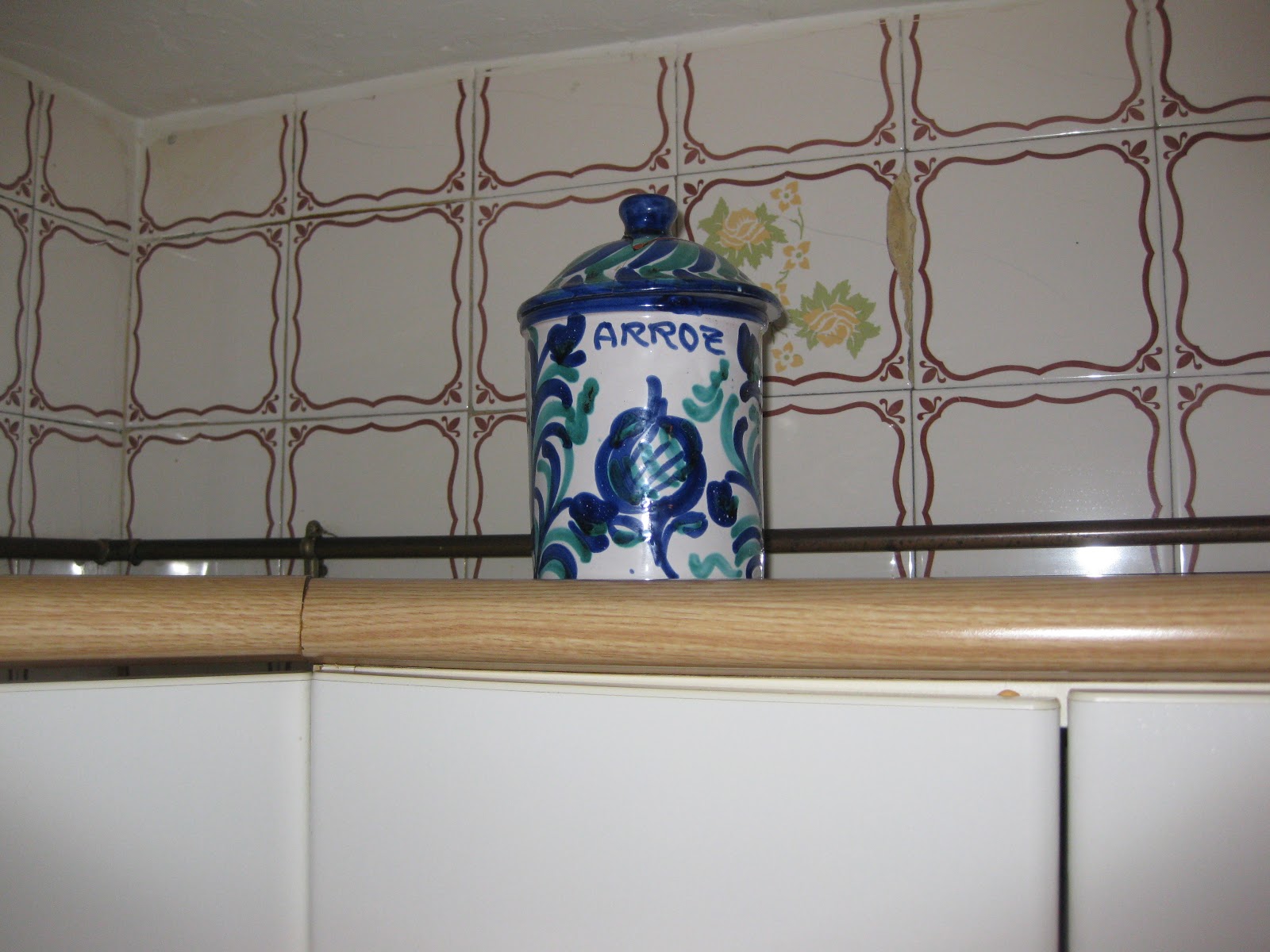
          Some other small granadas but ones that take up a large portion of the granadas in Granada are the ones on the street signs. The classic pottery here is made of only two colors: dark blue and a teal-ish color. They only depict pomegranates and certain other patterns. Every street sign is made up of these colors, a pomegranate at the top and below, el nombre de la calle. This type of pottery decorated with granadas is also everywhere in my host mom’s cocina (and in almost every cocina in Granada) for everything from arroz/rice to aceite to judias/beans.


A hidden granada in the bushes outside the API office


Last but not least, there are the granada trees themselves! The city would not be complete without these trees scattered about giving their fruits for us to enjoy. My friends and I picked off the last granada on one of the trees in the center of town, broke it open, and enjoyed it right there—a delicious granada on the streets of Granada.

A granada tree in the

Las granadas!

Me, Jiela, & Tyler eating one of the last granadas

 
This pride is one of my favorite aspects of Granada. For me, even though it’s a city of 500,000 people, it has the feeling a small town like my town of 6,000 people in Media, PA. The pride and prominence of the granadas provide a sense of unity—something everyone is proud of, something that connects everyone. I’ve never seen a city be so ingenious about something like this. Many cities I’ve encountered are proud of their city but never have I seen so much thought be put into truly making a city stand out as I have with las granadas en Granada.